Logan Schmitt · 2 September 2026
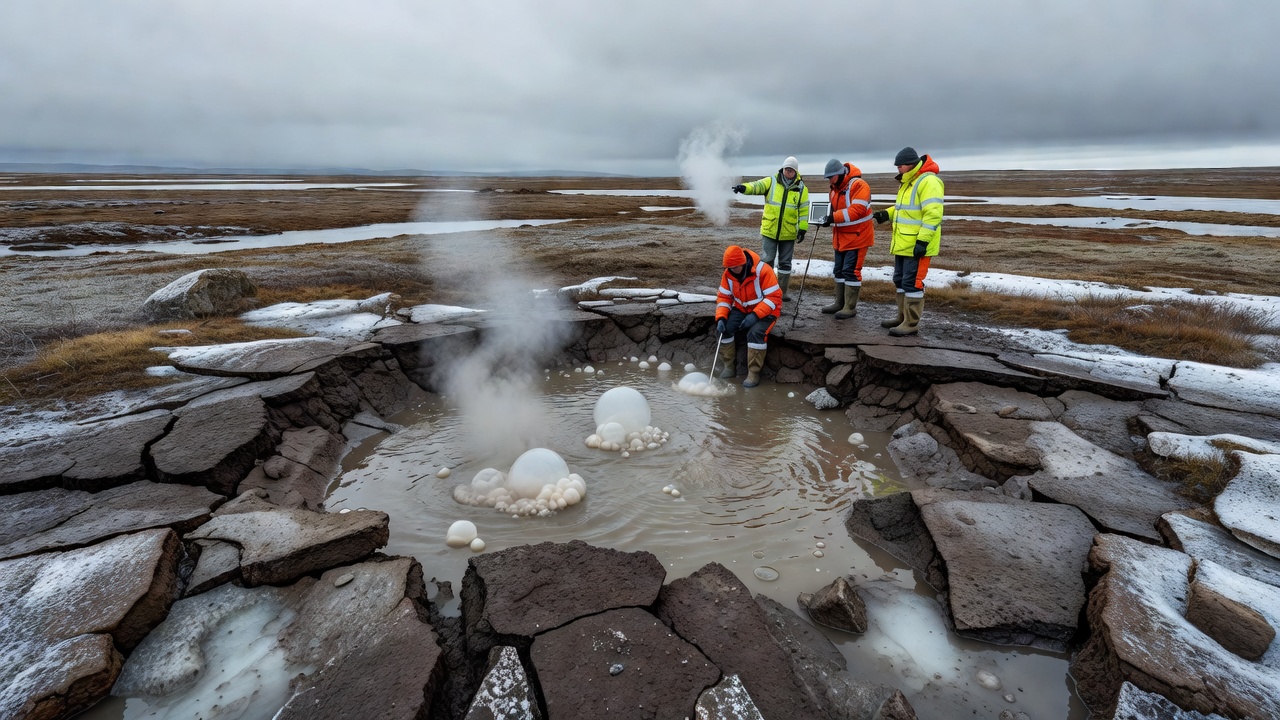
Recent field measurements across northern Siberia and Alaska indicate that permafrost thaw is releasing methane at rates substantially higher than models predicted a decade ago. Scientists attribute the surge to both gradual active-layer deepening and abrupt thermokarst formation, which exposes previously frozen organic carbon to microbial decomposition. Data collected during the 2023–2024 field season show methane fluxes from thaw features reaching 150 milligrams per square meter per day, nearly triple the regional average recorded in 2015.
Mechanisms Driving Increased Emissions
Permafrost soils store roughly 1,500 billion metric tons of organic carbon. As temperatures rise, this material thaws and becomes available to methanogenic archaea under waterlogged conditions typical of thermokarst lakes and wetlands. Laboratory incubations confirm that methane production accelerates once soil temperatures exceed −2 °C for sustained periods. In addition, talik formation beneath lakes creates year-round anaerobic environments that sustain emissions through winter, eliminating the seasonal pause previously assumed in carbon budgets. Satellite observations from the Sentinel-5P mission corroborate ground measurements, detecting enhanced atmospheric methane columns over the Lena River delta and northern Alaska during summer months.
Vegetation changes further amplify the process. Shrubs and sedges colonizing newly thawed ground transport methane directly from soil to atmosphere via aerenchyma, bypassing oxidation in surface layers. Isotopic analysis of emitted gas indicates a predominantly biogenic origin, ruling out significant contributions from geological seeps in the studied transects.
Research and Monitoring Initiatives
International teams coordinated by the Permafrost Carbon Network have expanded eddy-covariance towers and automated chamber networks to capture high-resolution flux data. These instruments now operate at 28 sites spanning continuous and discontinuous permafrost zones. Early results suggest that abrupt thaw features, though covering only 5 percent of the landscape, may account for up to 40 percent of regional methane emissions. Modeling groups are incorporating these observations into Earth-system models to reduce uncertainty in future climate projections. Educational programs at polarhub.edu.pl are using the new datasets to train students in remote-sensing analysis and biogeochemical sampling techniques, preparing the next generation of Arctic researchers.
Continued monitoring remains essential as feedback loops between thaw, emissions, and regional warming intensify. Policymakers and scientists emphasize that accurate quantification of these fluxes is critical for refining global greenhouse-gas budgets and informing mitigation strategies.