Willa Roth · 12 November 2026
Polar Training Programs Use Autonomous Underwater Vehicles to Study Microbial Shifts Under Ice
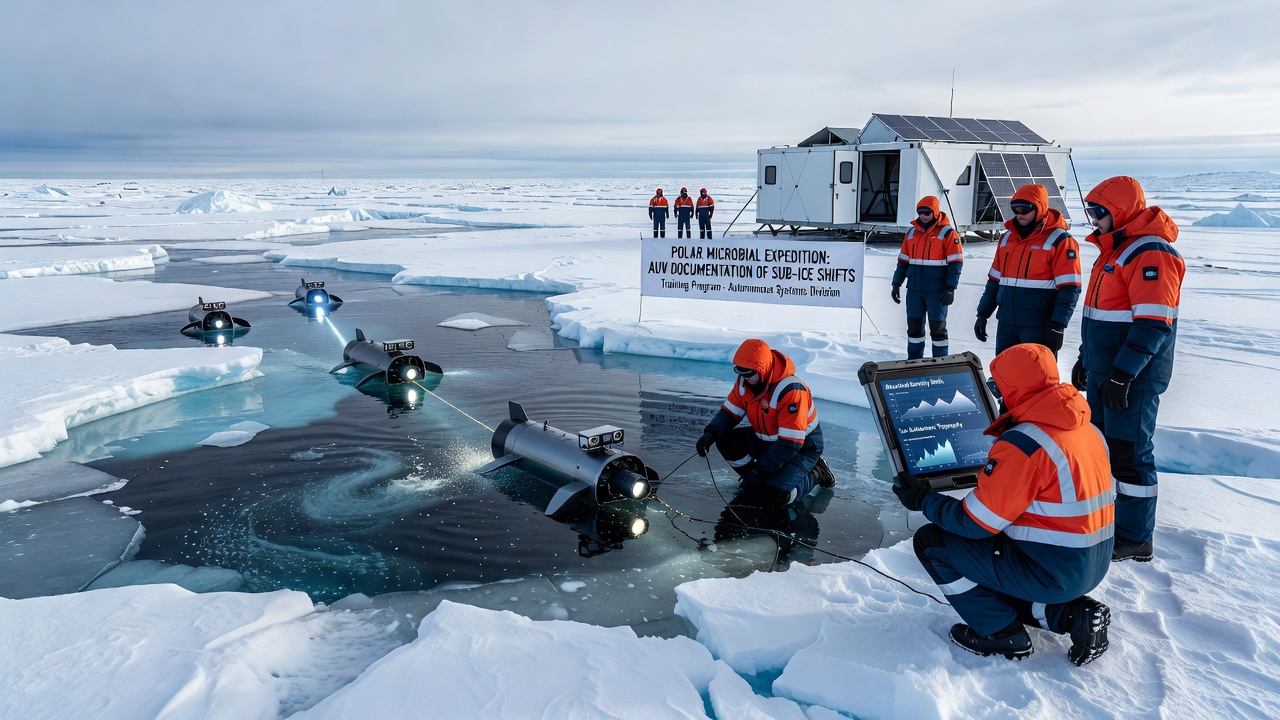
Expeditionary training programs have expanded their use of autonomous underwater vehicles to collect data on microbial communities living beneath polar ice sheets, and these efforts bring together university researchers with field operators who learn to navigate complex under-ice environments. Data collection focuses on shifts in bacterial and archaeal populations that respond to changing temperature and salinity conditions, while AUVs equipped with sensors for fluorescence, oxygen levels, and genetic sampling allow repeated measurements in areas previously reached only by limited manned dives.
Expansion of Training Initiatives
Programs run through institutions in Canada, Norway, and Australia coordinate seasonal deployments that combine classroom instruction with hands-on AUV operations, and participants practice mission planning that accounts for ice thickness variations and acoustic communication challenges beneath the surface. In November 2026 several cohorts completed certification modules that included simulated under-ice transects using data from prior Antarctic and Arctic campaigns, while instructors emphasized integration of real-time sensor feeds with historical records gathered by earlier expeditions.
Researchers note that microbial communities under ice sheets include psychrophilic bacteria that process organic carbon and influence nutrient cycles, and AUV-collected samples reveal seasonal changes in community composition tied to meltwater input and light penetration through thinning ice. Training exercises therefore incorporate protocols for sterile sample handling and onboard DNA extraction to preserve material integrity during multi-day missions that can cover dozens of kilometers.
Technical Capabilities of Deployed Vehicles
Modern AUV platforms carry modular payloads that combine imaging systems with environmental DNA collectors, and these tools enable mapping of microbial hotspots along the ice-water interface where brine channels concentrate nutrients. Operators in training programs practice adaptive sampling routines that adjust vehicle depth and speed based on detected chlorophyll fluorescence or turbidity spikes, which helps capture fine-scale variations across gradients that span just a few meters. Data transmission occurs through acoustic modems when vehicles surface at polynyas or leads, and teams review profiles during post-mission debriefs to refine navigation parameters for subsequent runs.
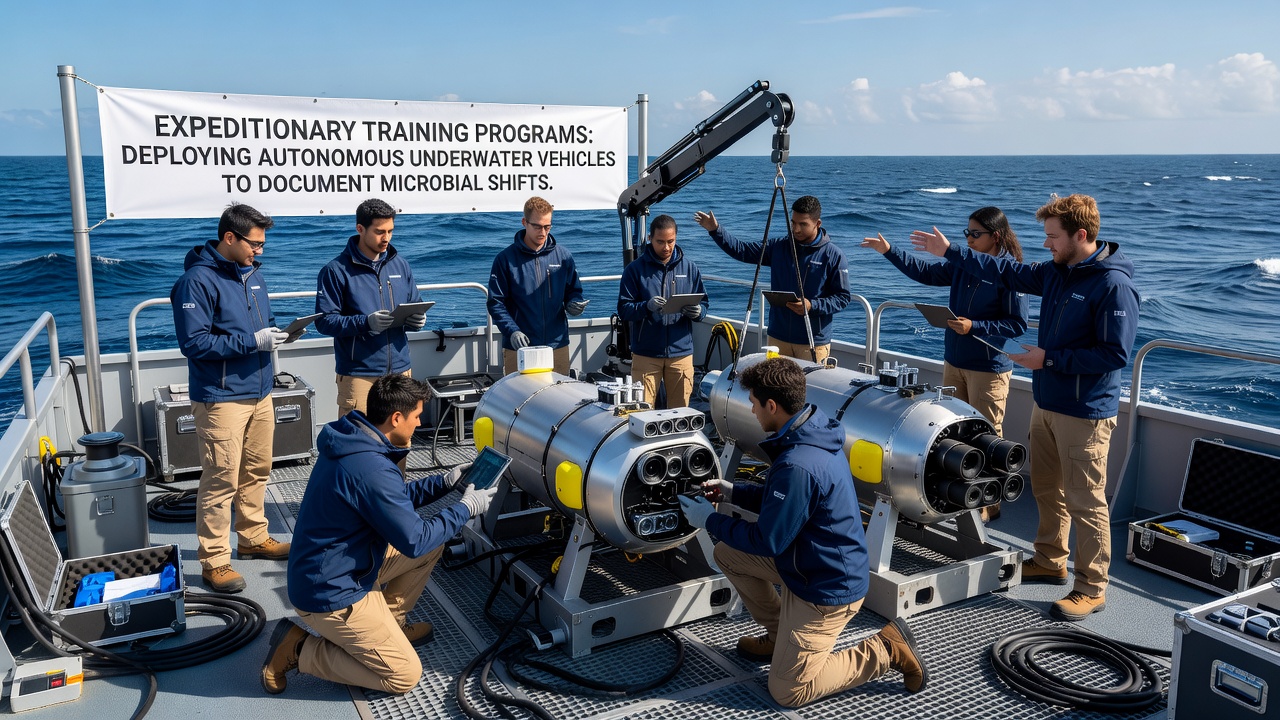
Evidence from multiple campaigns shows that certain archaeal groups increase in abundance near grounding lines where subglacial discharge introduces different chemical signatures, and training modules now include case studies drawn from both Arctic fjords and Antarctic shelf sites to illustrate these patterns. Participants learn to interpret conductivity-temperature-depth profiles alongside microbial abundance counts, and they practice quality-control checks that flag anomalies caused by biofouling on sensor surfaces during extended deployments.
Geographic Scope and Data Integration
Training sites span the Canadian Arctic Archipelago, the Svalbard archipelago, and coastal regions of East Antarctica, and each location supplies distinct baseline datasets that trainees compare during joint analysis sessions. Coordination with national programs allows sharing of AUV track logs and metagenomic sequences through centralized repositories, while metadata standards ensure that results from different vehicles remain comparable across years. Observers report that integration of these datasets highlights consistent trends in microbial diversity decline correlated with increasing freshwater input, although local factors such as sediment resuspension produce site-specific deviations.
According to records maintained by the Polar Continental Shelf Program, AUV missions conducted during the 2025-2026 season logged over 180 kilometers of under-ice transects, and similar efforts supported by Australian and European partners added complementary coverage along the Antarctic Peninsula. Training curricula incorporate these figures to demonstrate scaling requirements for future multi-vehicle operations that could survey entire ice-shelf cavities within single seasons.
Future Directions in Program Development
Upcoming curriculum updates plan to add machine-learning modules that help operators identify microbial bloom signatures from onboard sensor streams in real time, and these additions build on existing partnerships with oceanographic institutes that supply annotated datasets for algorithm training. Field exercises scheduled for late 2026 will test coordinated fleets of AUVs that communicate position and sensor status acoustically, reducing the need for frequent surfacing and extending mission duration under continuous ice cover. Such advances support longer-term monitoring objectives that track how microbial processes respond to sustained changes in ice-shelf geometry and sub-ice hydrology.
Conclusion
Expeditionary training programs continue to refine AUV deployment methods that document microbial shifts beneath polar ice sheets, and the resulting datasets contribute to broader understanding of polar ecosystem responses. Coordinated efforts across multiple nations maintain consistent data standards while expanding the number of trained personnel capable of operating in these remote environments. Ongoing integration of new sensor technologies and analytical approaches sustains the capacity to capture detailed spatial and temporal patterns in under-ice microbial communities.