David Patterson · 1 October 2026
Polar Waters' Rising Acidity Poses New Challenges for Krill Survival, Studies Indicate
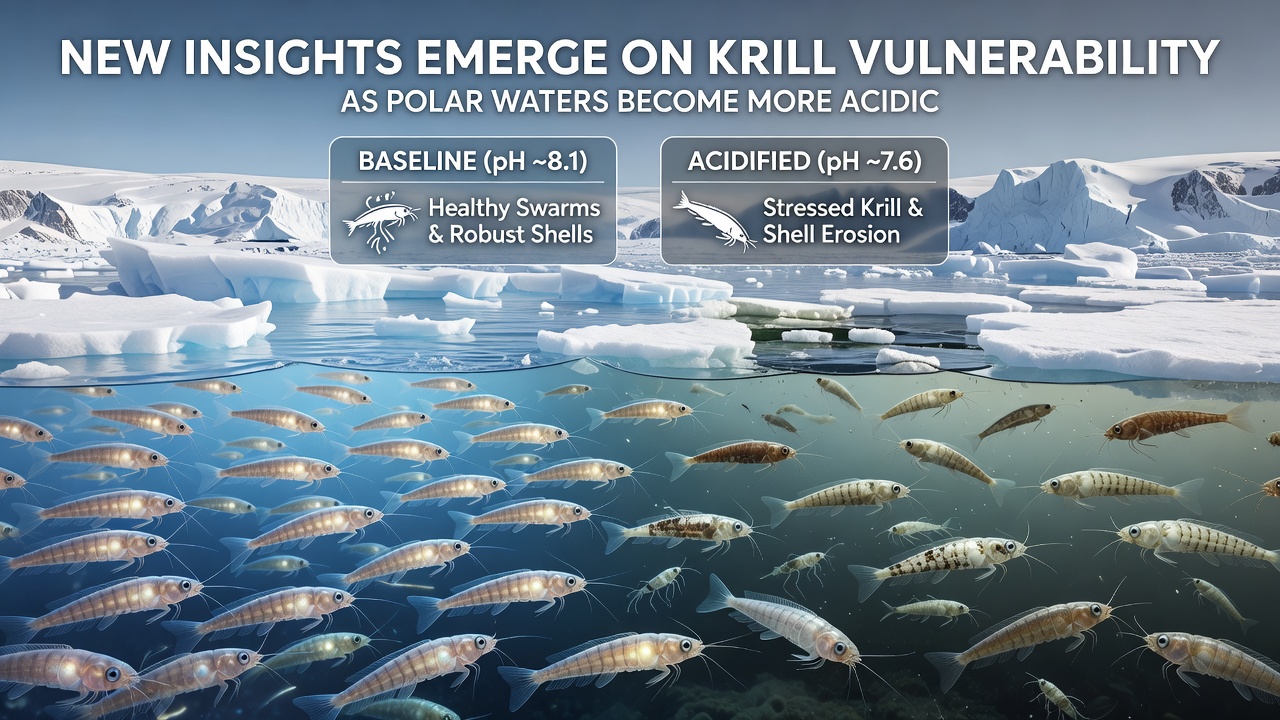
Researchers have documented how ocean acidification alters krill physiology in both Arctic and Antarctic regions, with data collected through 2026 showing measurable impacts on larval development and shell formation. Studies released in October 2026 from multiple international teams reveal that pH levels dropping below 7.8 correlate with reduced hatching success rates in Euphausia superba populations, the dominant Antarctic krill species. These findings build on earlier monitoring programs that tracked carbonate chemistry shifts across the Southern Ocean and parts of the Arctic Basin.
Understanding the Chemical Shifts in Polar Oceans
Carbon dioxide absorption drives pH declines in cold polar waters more rapidly than in temperate zones because lower temperatures increase gas solubility, and this process accelerates shell dissolution in calcifying organisms like krill. Data from long-term buoy arrays indicate average surface pH in the Weddell Sea fell by 0.12 units between 1990 and 2025, while similar trends appear in the Barents Sea where Arctic krill species such as Thysanoessa raschii encounter comparable conditions. Scientists note that these changes disrupt the formation of calcium carbonate structures during early life stages, leading to higher mortality before juveniles reach maturity.
Impacts on Krill Life Cycles and Ecosystems
Krill serve as a foundational species that transfers energy from phytoplankton to higher trophic levels including whales, seals, and penguins, so any reduction in their abundance ripples through entire food webs. Field observations conducted during the 2025-2026 austral summer found that krill larvae exposed to elevated CO2 concentrations exhibited slower growth rates and altered swimming behavior, which in turn affects their ability to avoid predators. In the Arctic, parallel research on Meganyctiphanes norvegica shows comparable vulnerabilities during molting periods when exoskeletons become more susceptible to corrosive conditions.
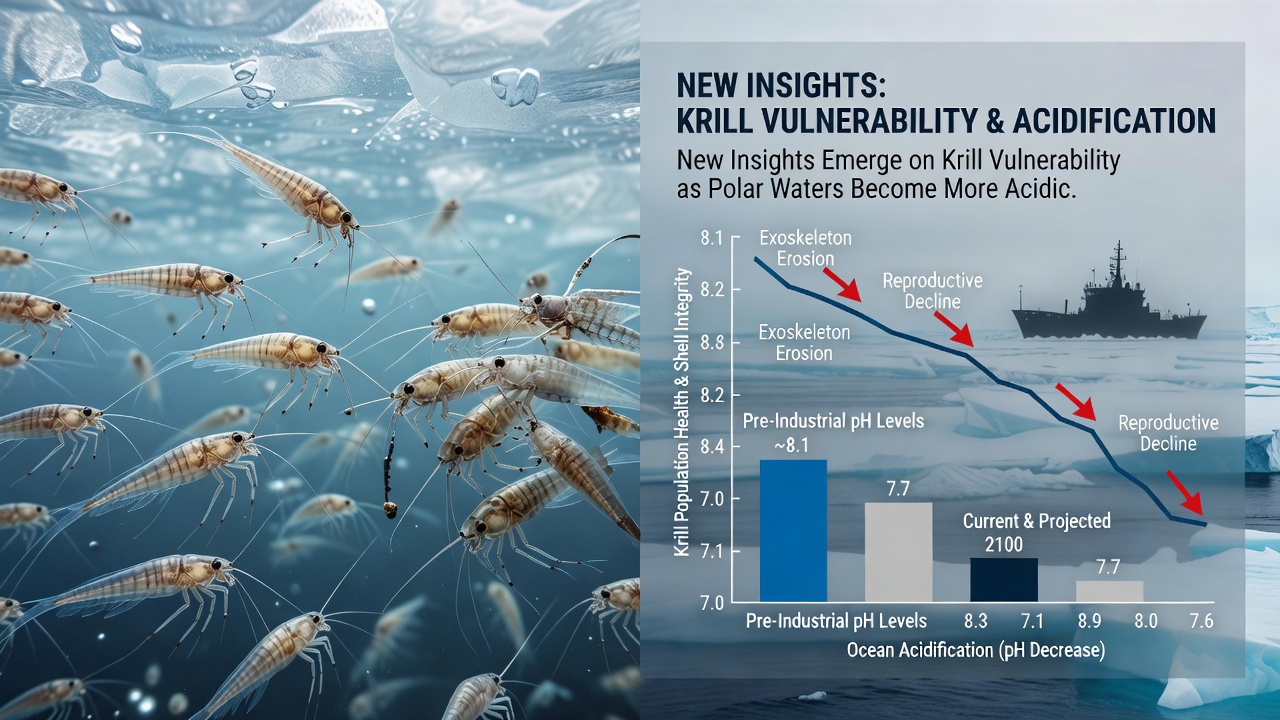
One study released through the British Antarctic Survey tracked krill cohorts across multiple seasons and found that survival to adulthood dropped by approximately 18 percent in regions where aragonite saturation states remained below 1.0 for extended periods. Another project coordinated by Australian researchers mapped regional differences, noting that areas near the Antarctic Peninsula experience faster acidification due to upwelling of deep water masses already enriched with respiratory CO2. These patterns align with broader observations that seasonal ice melt further dilutes surface alkalinity and intensifies local effects.
Monitoring Efforts and Data Collection Methods
Autonomous underwater vehicles equipped with pH sensors and plankton nets have expanded coverage in previously inaccessible zones, delivering continuous records that complement ship-based sampling. In October 2026 several teams published integrated datasets combining satellite chlorophyll measurements with in-situ krill density counts, revealing that bloom timing shifts may compound acidification stress by altering food availability during critical larval phases. Government agencies such as the Environment and Climate Change Canada contributed Arctic-focused transects that document parallel trends north of the Bering Strait.
Genetic analyses conducted on preserved specimens indicate potential for adaptive responses over multiple generations, although the pace of environmental change may outstrip natural selection capacity in many populations. Laboratory experiments that simulate projected 2050 pH levels demonstrate reduced lipid accumulation in krill, which directly affects their nutritional value for predators and their own overwintering survival strategies.
Regional Variations and Future Projections
Models developed by European research consortia project that parts of the Southern Ocean could reach pH thresholds detrimental to krill by the mid-2030s under current emission trajectories, whereas some Arctic shelf regions already experience episodic corrosive events during winter months. Observers note that interactions with warming temperatures and changing sea-ice extent create compound stressors that single-factor studies cannot fully capture. Ongoing international programs continue to refine these projections by incorporating new field measurements collected through 2026.
Conclusion
Collective evidence from polar research networks underscores the sensitivity of krill to declining ocean pH and highlights the need for sustained monitoring across both hemispheres. Continued integration of chemical, biological, and modeling approaches will clarify how these foundational species respond over coming decades and inform conservation planning in polar marine systems.